Not every parcel that comes back was refused. Some never met their buyer at all: the courier could not find the house, the phone rang out, or the customer was at work on the other side of town. Nobody said no; nobody was found. These failures have specific causes, and most of them can be fixed before the parcel leaves your warehouse: on the order form, during the confirmation call, and while the courier is out on the round. This article is only about them. To measure and reduce your return rate as a whole, refusals included, read our COD return-rate guide.
What a parcel that never finds its buyer costs
At the Logismed 2026 trade show, the head of a logistics group put the problem in one line: "the last mile kills the margin". By the figures he gave, between 30% and 40% of deliveries need a second attempt because the customer is absent, does not answer or asks for another visit. He estimates that 60% to 70% of delivery costs are lost in those re-deliveries and in returns. These are one industry player’s orders of magnitude, not official statistics, but the point stands: a second attempt is not an accident, it is a cost line.
Each failed attempt costs you more than once. The courier comes back, and your stock sits idle another day. The customer gets another day to change their mind, find the product elsewhere or forget why they ordered it. A parcel that finally returns after two or three attempts has used up the ad spend, the confirmation call, the packing and the transport, and earned nothing.
So separate three situations that many sellers file under a single "return" label:
- refused: the courier found the customer, who declined the parcel;
- unreachable: the number rings out, is switched off or does not exist;
- address not found: the customer may answer, but nobody can locate them, or they are not there when the courier comes.
Refusals are mostly about your offer and your confirmation. The other two come down to the quality of the data you hand the carrier, and that is what the rest of this article deals with.
Why so many Moroccan addresses cause trouble
Nobody disputes the diagnosis. An opinion piece in Journal du Net says it plainly: Morocco’s addressing system is complex and poorly standardised, which makes parcel delivery harder. YouCan’s blog likewise lists inaccurate or unclear addresses, especially in certain areas, among the main delivery challenges in the country.
Part of it is geography. The 2024 census puts the urbanisation rate at 62.8%, which leaves a rural population of 13,718,222 people. In a douar reached by a dirt track there is often no street name and no house number; deliveries are made by the mosque, the school or the corner shop. Cities have their own traps: new housing estates whose streets have no names yet, residences of several blocks with no visible numbers, neighbourhood names spelled three different ways, and city names typed in shorthand, in Arabic or with a typo.
Postcodes do not solve much. Barid Al-Maghrib does publish a list of neighbourhood postcodes on the national open-data portal, but the record shows its last update as September 2018, and few customers know their code anyway. What a COD courier needs is the city, the neighbourhood, a street if there is one, and above all a landmark they can recognise.
An order form that collects a deliverable address
Address quality starts on the product page. A single "Address" box lets the customer type "Casa" or "next to the café" and leaves you rebuilding everything on the phone. A few simple rules make a big difference:
- City from a list, not free text. Offer exactly the cities your carrier serves, spelled the way the carrier spells them. You avoid typos and know at once whether the city is covered.
- Neighbourhood as its own required field. It is what lets the courier plan the round.
- Address with an example under the field: street, number, building, floor, flat.
- A "landmark" field: "opposite the pharmacy", "behind the mosque", "next to the primary school". It is often the first thing the courier reads.
- An optional location. Google’s Plus Codes work like street addresses for places that do not have one, so a business can find the right spot even without street names and numbers, and they work offline too.
Do not make the form so long that buyers give up. Anything that is not required at checkout, such as a pinned location or a precise landmark, can be filled in during the confirmation call. What matters is that the form stops letting through empty or absurd values: an unknown city, a one-letter neighbourhood, an address that is just the customer’s name.
The phone number: the first cause of no-answers
A courier who cannot call the customer does not deliver. A mistyped number easily goes unnoticed until the day of the round, even though the Moroccan format is easy to check: since the numbering plan reform, users dial ten digits, and mobile numbers start with 06 or, since the telecoms regulator ANRT opened the prefix, with 07, in the form 07AB xxxxxx.
In practice your form or your tool should:
- strip spaces, dashes and dots, and convert the international prefix to the national format;
- reject any number that is not ten digits long or does not start with 06 or 07;
- flag suspicious sequences (the same digit repeated, a straight run) for a check first;
- spot a number already linked to unreachable parcels in your history;
- offer an optional second number, a relative who can be reached during the day.
A landline starting with 05 may be genuine, but it receives no WhatsApp and nobody answers it once the customer is out. Ask for a mobile during confirmation. And do not confuse this with hunting fake orders: a number that is wrong because of a typo belongs to a real customer, who can often be reached on the right number found in a message or a second order.
Confirm the address, not just the order
Many confirmation calls stop at "Do you confirm the order?". A parcel that has to find its buyer needs more, which is also YouCan’s advice: confirm the address before shipping. During the call, the agent should:
- read back the city and neighbourhood, and pin down the street or residence;
- ask for a landmark the courier can see from the street;
- ask where the customer will be over the next two days: at home, at work, at their parents’. Delivering to an office beats a second attempt;
- warn that the courier will call from an unknown number, and that they should pick up;
- write all of this in the note sent to the carrier, in short sentences.
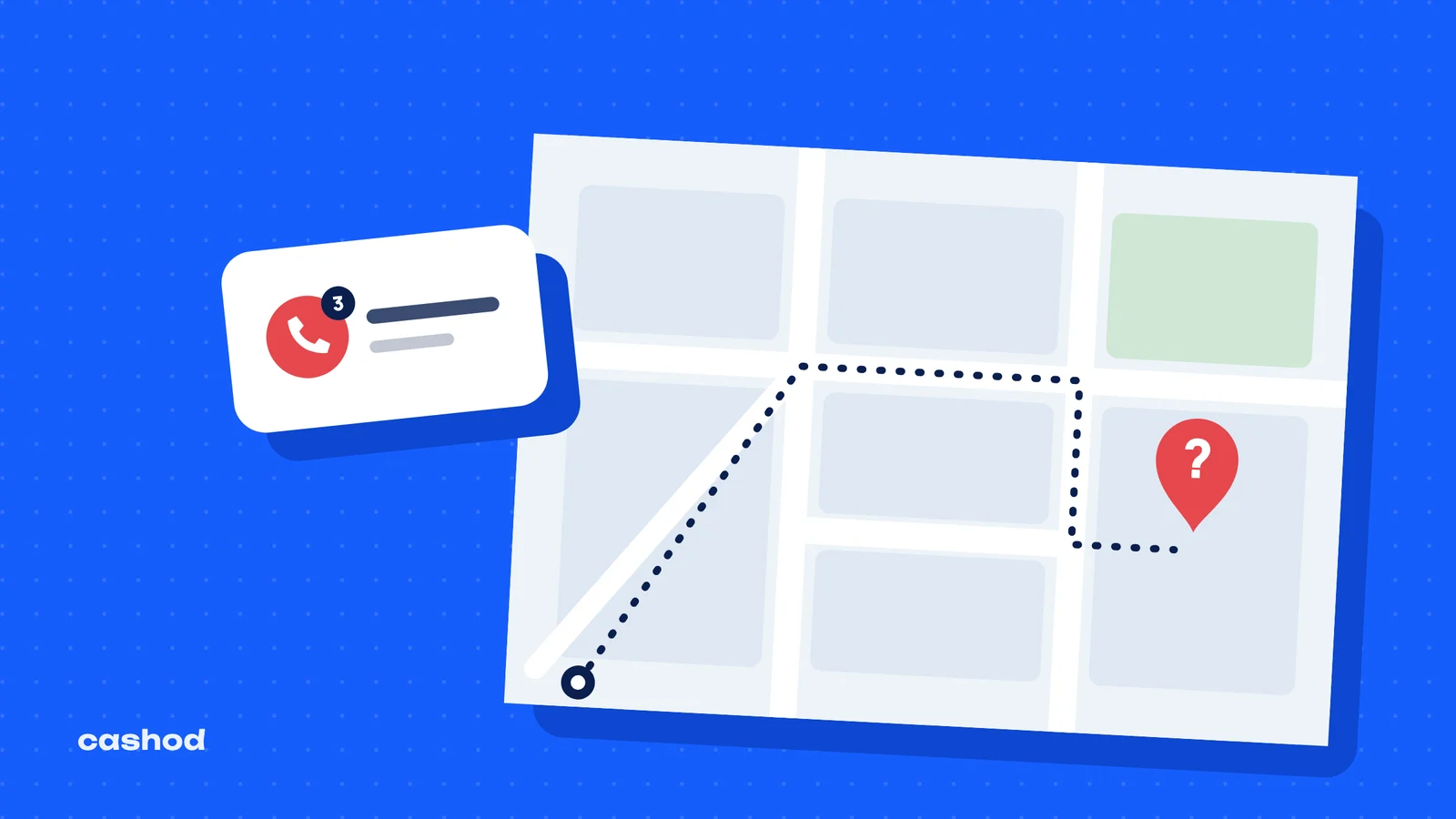
When the address stays vague, ask the customer to send their location on WhatsApp. With Live Location, each person in the chat sees the real-time location on a map, and the customer chooses how long to share it. A static pin is usually enough, and it can be pasted straight into the delivery note. In rural areas, agree on a well-known meeting point instead: the souk entrance, the petrol station, the village shop.
Our article on COD order confirmation walks through the whole call, and our Darija call scripts give the exact phrases for asking about a landmark or availability without putting the customer off.
When the courier cannot reach the customer
Even with a clean address, some attempts will fail. What matters then is how fast you react. Some carriers build a step for this into their offer: Ameex lists a customer reminder before return and SMS tracking for your customer, and Cathedis offers to manage returns online when the customer is unreachable or cancels. Read your contract: how many attempts are included, how long the parcel waits at the depot, and who is supposed to call the customer back.
Do not leave it to the carrier alone. Set up your own follow-up:
- as soon as a parcel goes to "unreachable", "postponed" or "wrong address", an agent calls the customer the same day from the store’s number, which they recognise;
- if there is no answer, a short WhatsApp message recalls the order and the amount and asks for a time slot;
- the new address, landmark or date goes to the carrier straight away;
- after several unanswered contacts, accept the return rather than tie up stock indefinitely.
For customers who are never home when couriers come by, a pickup point or a parcel locker is a real alternative. Le Matin describes a project for smart lockers that let customers collect their parcel at any time with a code sent by message. If your carrier offers this kind of handover, suggest it during confirmation to anyone who mentions awkward hours.
Measure failures by cause, city and carrier
What you do not measure does not go down. For every undelivered parcel, record one cause, and only one, from a short list:
| Cause | Signal | First action |
|---|---|---|
| Invalid number | Number does not exist or belongs to someone else | Format validation on the form |
| No answer | Rings out, switched off | Warn about the courier’s call, second number |
| Absent | Reached, but not on site | Ask about availability, deliver to work |
| Address not found | Courier cannot locate the place | Landmark field, WhatsApp location |
| City not covered | Parcel stuck or transferred | City list matched to the carrier |
Then work out the share of shipped parcels that end up unreachable or not found, and break it down by city, carrier, ad campaign and confirmation agent. A city where addresses keep going missing calls for a mandatory landmark. A campaign that brings in wrong numbers raises a targeting question. An agent whose orders come back "absent" more often than others is probably skipping the availability question. For the general method, refusals included, see the return-rate guide.
Running this with Cashod
Cashod includes a call center where agents confirm COD orders by phone: that is where the address check and the callbacks to unreachable customers happen. Cashod can also confirm orders over WhatsApp, including with an AI agent, which gives customers who do not pick up a second channel.
Cashod tracks returned parcels, and each carrier’s delivery and return fees are set per city. You can therefore see which cities cost you most in failures, and what they cost with each carrier. Returns management has its own page.
The integrated carriers are Sendit, Ozon Express, Ameex, Cathedis, Forcelog, Onesta, Kargo Express, Speedaf, Gold Colis, Express Relais, HL Express, Livo, Olivraison, Digylog, Navex. Any other carrier can be added manually, without automatic shipment creation or tracking. And one Cashod account can manage several stores.
The checklist before every shipment
- The city is on the list of cities the chosen carrier serves.
- The neighbourhood is filled in, plus the street or residence when there is one.
- A landmark visible from the street is noted.
- The number has ten digits, starts with 06 or 07 and answered during confirmation.
- The customer knows when and where they will be available, and that a courier will call.
- For a vague address, a WhatsApp location is attached to the delivery note.
- The note sent to the carrier is short, readable and free of cryptic abbreviations.
None of these steps needs a big investment. Together they turn part of your "unreachable" parcels into delivered ones, and that is often the cheapest way to win more deliveries.