Every late November, the same story plays out in many Moroccan cash-on-delivery stores. The “Black Friday” ads go live, orders pour in, the confirmation team is underwater by day two, the carrier picks up late, and a few weeks later returns come back in batches and the month’s margin is gone. Demand was never the problem; preparation was. With cash on delivery, an order only counts once the parcel is delivered and the cash collected. Getting ready for a sales peak therefore means getting the whole chain ready — offer, stock, confirmation, delivery, returns — not just the ad campaign. This guide applies to Black Friday, the year-end season and the summer sales alike.
Why a sales peak is riskier for a COD store
Black Friday has taken root in Morocco. According to an analysis by Concli of DHL’s 2025 e-commerce trends report, Morocco ranks 4th globally in trust toward Black Friday deals. The same data, however, describes shoppers who compare before they commit: 82% of Moroccan consumers browse products online multiple times a week, yet only 29% make purchases as frequently. Moroccan coverage of the study lists the reasons for that caution, and every COD seller will recognise them: delivery reliability, price transparency, clear return policies and the growing weight of customer reviews.
Cash on delivery is still the most widespread way to pay. Morocco keeps one of the world’s highest rates of cash-on-delivery, at 54%, even as card payments (88%) and digital wallets (72%) become mainstream. For a COD seller this means two things. First, a large share of year-end demand will reach you through an order form with no upfront payment. Second, every extra order adds a confirmation call, a parcel to pack, a courier visit and a chance of refusal.
That is where a peak turns dangerous. Promotions attract more impulsive buyers: an economist interviewed by SNRTnews argues that a large share of purchase decisions in this period are made on impulse, without weighing the need. In COD, today’s impulse is tomorrow’s refusal. The customer who ordered in the rush of a countdown timer is not the same person when the courier calls several days later. The longer the gap between order and delivery grows during the peak, the bigger that risk.
Black November, year-end and summer: the peak calendar
Black Friday is no longer a single Friday. In 2025 it fell on Friday 28 November, but many retailers launched their promotions well ahead and spread them across the whole month, a stretch now often called “Black November”. Jumia, which pioneered the event in Morocco, ran its 2024 edition from 1 to 29 November, and its CEO describes it as “a real organisational manoeuvre”. For platforms, the event can double or even triple revenue. If a player of that size plans it like a logistics operation, an independent store has even less room to improvise.
For a COD store it helps to think in three seasons:
- November, the extended Black Friday. The most competitive season: big retailers crowd the ad space and buyers compare. A clear offer and fast delivery matter more here than a spectacular discount.
- December and January, year-end and the winter sales. Gifts, warm clothing, home goods: retailers traditionally make a good part of their revenue in the sales season. Check your carrier’s pickup days around public holidays.
- Summer, the summer sales and the big trips. Moroccans abroad coming home, weddings, back-to-school shopping: demand shifts to other categories and other cities, coastal ones in particular.
Pick one or two of these windows rather than chasing all of them. One well-prepared peak earns more than three that catch you off guard.
Struck-through prices and sales: what law 31-08 says
In Morocco, sales fall under law 31-08 on consumer protection. Under its article 53, sales are transactions accompanied or preceded by advertising that announces the accelerated clearance of goods in stock through a price reduction. Three rules apply directly to your product pages and ads:
- Announce the period. Under article 55, any advertising for a sale states its start date, its duration and the type of products involved, if the sale does not cover the whole catalogue.
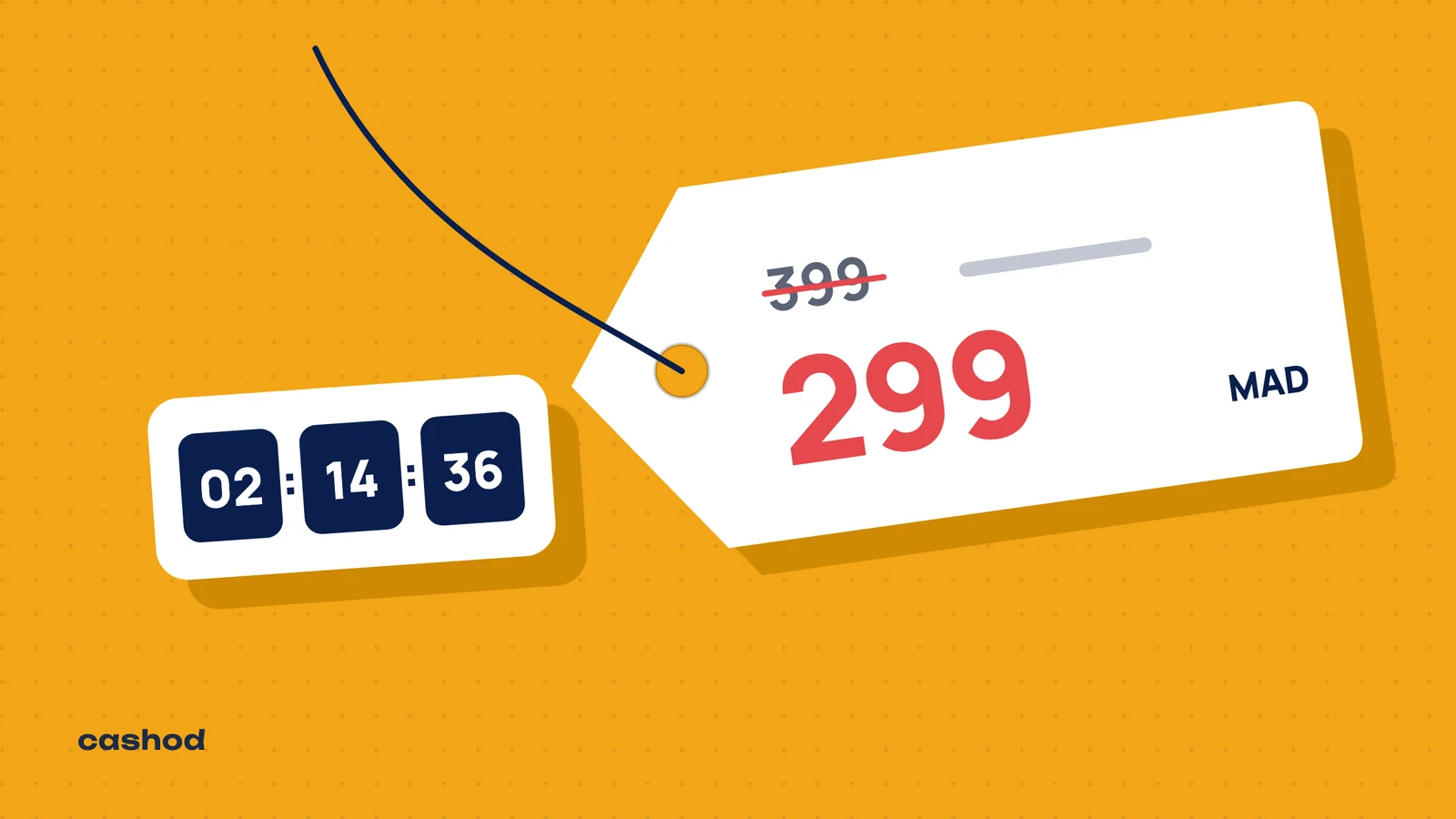
- Show the old and the new price. Article 54 requires a clear, legible display of the word “sales”, with the new price and the old price struck through.
- Use a real old price. The struck-through price cannot exceed the lowest price actually charged in the 30 days before the sale begins.
The law sets no exact periods for promotional offers, and consumer groups have long complained about weak enforcement. That is no reason to play with the numbers. The press has documented the abuses: one site listed a phone usually sold for 1,100 DH at 1,050 DH while showing an “original” price of 2,500 DH, an apparent discount of 58%, when the real reduction was under five percent. Others made up for the discount by raising the delivery fee. The head of the Moroccan Federation of Consumer Rights also points to offers circulating on social networks with no oversight at all.
In COD, cheating costs you twice. The customer discovers the real price when paying the courier, or compares online while the parcel is on the road; they refuse, and you pay for the outbound trip, the return and the ad. Distance selling also gives the buyer 7 days to change their mind, sale or no sale. The safest rule is simple: a struck-through price you actually charged the month before, start and end dates on display, and a total price including delivery stated in the ad and repeated on the phone. These pointers are not legal advice; check with a lawyer on any specific doubt.
An offer that stays profitable after returns
A discount is judged on the delivered order, not the order received. Before choosing a percentage, redo your profit per delivered order with peak assumptions: a higher acquisition cost, because ad competition climbs in November; a delivery rate that will probably be lower; and return fees on refused parcels. If the margin does not survive that cautious scenario, the promotion will bring volume, not profit.
A few principles hold up well in COD:
- Prefer bundles to straight discounts. “Buy two, get the third free” or a free accessory raises the basket without crushing the unit price, and a pricier parcel absorbs fixed delivery costs better.
- Offer free delivery rather than a big percentage where your per-city fees allow it. The customer sees a final price with no surprise, and surprise is exactly what triggers refusals at the door.
- Only promote what you have in stock. Advertising a deal on an item that has sold out, then offering “something else” on the phone, damages trust for the whole season.
- Set an end date and keep it. It is mandatory for sales, and an honest countdown is more credible than an “exceptional” offer renewed every week.
Stock and suppliers: decide six weeks ahead
Stock is the slowest constraint to fix. A local supplier who meets deadlines all year may stretch them in November, when every client orders at once; imports need even more lead time. Start from the sales of your previous peak or, failing that, your best weeks, and set three numbers for each product: the target volume, the safety stock and the threshold at which you switch off its ads.
Remember that stock leaves twice. Refused parcels leave the warehouse and only come back several days later, and in the meantime nobody else can buy them. A best-seller with part of its stock on the road back can sell out while the dashboard still shows units. Count available stock, shipped-but-undelivered stock and stock in return separately.
Prepare what is not the product, too: boxes, mailing bags, labels, printer ink, tape. Running out of packaging blocks shipping just as surely as running out of stock.
Size your confirmation team before day one
In COD, confirmation is the bottleneck of a peak. An order waiting for its call goes cold: the customer forgets, buys elsewhere or stops answering. The goal is not just to call everyone but to call fast, ideally on the day the order comes in.
- Work out capacity. Multiply expected daily orders by the average number of call attempts, then compare with what one agent handles in a day. The gap tells you how many extra hands you need.
- Hire and train before November. An agent trained on peak day learns on your best customers. Give them Darija call scripts written for the offer: total price, what the bundle contains, end date, delivery time.
- Extend the hours. Promotional orders arrive in the evening and at weekends. A team that only works weekday office hours builds a backlog it never clears.
- Add a written channel. A WhatsApp message summarising the order reaches customers who do not pick up during office hours and leaves a record of the price they accepted.
- Filter more, not less. Duplicates, invalid numbers, incomplete addresses, customers who have refused several parcels before: during a peak the temptation is to ship everything. Do the opposite, because every pointless parcel ties up a courier and comes back with fees.
Warn your carrier and keep the delivery times you promise
Moroccan shoppers put delivery reliability among the deciding factors when they buy. During a peak, though, your carrier receives every client’s volume at the same time. Warn them several weeks ahead: estimated daily volume, main cities, pickup times. Ask for their real delivery times during that period, not the ones in the brochure.
- Split the cities. A second carrier for some regions keeps you from depending on one saturated network. Compare rate cards with our COD delivery prices by city.
- Ship every day. Several medium pickups beat one huge shipment at the end of the week.
- State an honest delivery time on the product page and on the phone. A customer who was told waits; a customer who is surprised cancels.
- Offer pickup when you can. During its Black Friday, Jumia let customers collect their orders from relay points across the kingdom. If your carrier runs relay points, they are a useful option for customers who are often out.
A countdown plan for a sales peak
| When | What |
|---|---|
| Six to eight weeks before | Choose products and offer, recalculate margin per delivered order, place supplier orders |
| One month before | Warn carriers, hire and train extra confirmation agents, order packaging |
| Two weeks before | Build pages and ads with dates, genuine struck-through prices and total price; test the order form on mobile |
| During the peak | Confirm the same day, ship daily, pause ads for products below their stock threshold |
| After the peak | Track returns, reconcile payouts, review results by product, city and carrier |
After the peak: returns, payouts and review
The peak ends for your ads long before it ends for your cash flow. Refused parcels keep coming back for weeks, and the money from delivered parcels arrives at the pace of the carrier’s payouts. Match every payout against the parcels actually delivered, and check that each announced return really came back into stock, in good condition, before you put it on sale again.
Then review with the right denominators: confirmation rate, delivery rate on shipped parcels, ad cost per delivered order, broken down by product, city and carrier. That review is the raw material for the next peak. And the customers you delivered during Black Friday are your best audience for the year-end season: they already trusted you enough to pay a courier.
Handling the peak with Cashod
Cashod brings together the steps that crack first during a peak. It includes a call center where agents confirm COD orders by phone, and it can confirm orders over WhatsApp, including with an AI agent, which takes pressure off the team in the evening and at weekends. Cashod tracks returned parcels, and each carrier’s delivery and return fees are set per city, so you can see what every return of the season really cost. Finally, one Cashod account can manage several stores, which helps if you open a store dedicated to a seasonal campaign.