Sooner or later every online seller in Morocco gets the same request, from a business customer, a supplier or the bank: “Can you send me an invoice with VAT?” The answer depends on what you do, what you sell and how much you turn over. It does not depend on the sales channel. Morocco’s General Tax Code (CGI) has no separate regime for online shops or cash on delivery, but several of its rules apply very directly to a COD parcel.
This guide follows the rules as they stand in the 2026 edition of the General Tax Code published by the Directorate General of Taxes (DGI): who has to charge VAT, at what rate, on what amount and when, what an invoice must contain, how to file, what to keep and what electronic invoicing will change. If you are an auto-entrepreneur, start with our guide to auto-entrepreneur status for e-commerce: that status sits outside VAT, and this article becomes relevant the day you outgrow it.
Are you liable for VAT?
Selling is not enough to make you liable. Article 89 of the CGI lists the operations that must bear VAT, and four situations matter for an online seller:
- You resell finished products at retail. A reselling trader becomes liable once turnover in the previous year is equal to or above 2,000,000 DH. After that, the trader can only leave VAT after three consecutive years below that amount.
- You sell wholesale. Wholesale traders are taxable, with no threshold.
- You import yourself. VAT applies to sales of imported products resold as they are by importing traders, whatever their turnover. If goods clear customs in your name and you resell them unchanged, this is you.
- You make, or have things made. The CGI covers products “extracted, manufactured or packaged” by the seller, and counts assembly, assortment and commercial presentation as manufacturing, including when a third party does the work. A brand that has its cosmetics produced, or repackages goods under its own name, can therefore be treated as a manufacturer. Manufacturers and service providers who are natural persons with annual turnover of 500,000 DH or less are exempt, without the right to deduct.
Legal form does not change these rules: the CGI applies VAT whatever the status of the person carrying out the operation. A limited company (SARL) reselling at retail below the threshold is not liable for that reason alone, and an individual who imports is. A reseller below the threshold can also opt into VAT, for at least three consecutive years. That helps when most customers are businesses that recover VAT, much less when you sell to consumers, for whom VAT is simply a cost.
Rates: 20% and 10%
The reform launched by the 2024 finance law planned to bring the 7%, 10%, 14% and 20% rates down to two rates, 20% and 10%, by 2026, and it also set out to widen VAT to e-commerce. That is now done: since 2026 Morocco applies two VAT rates, the normal rate of 20% and the reduced rate of 10%, and the former 14% and 7% rates are gone.
The reduced rate covers a closed list in the CGI (hotels and restaurants, some edible oils, milled rice, certain pasta, cooking salt, solar water heaters and so on). Clothing, cosmetics, accessories, electronics and homeware sold online generally fall under the normal rate. Some basic goods, such as bread and milk, are exempt. Check your product’s exact line in the code rather than assuming.
On imports, customs collects VAT when the goods are cleared. It adds to your purchase cost and, if you are a VAT taxpayer, is recovered through your returns.
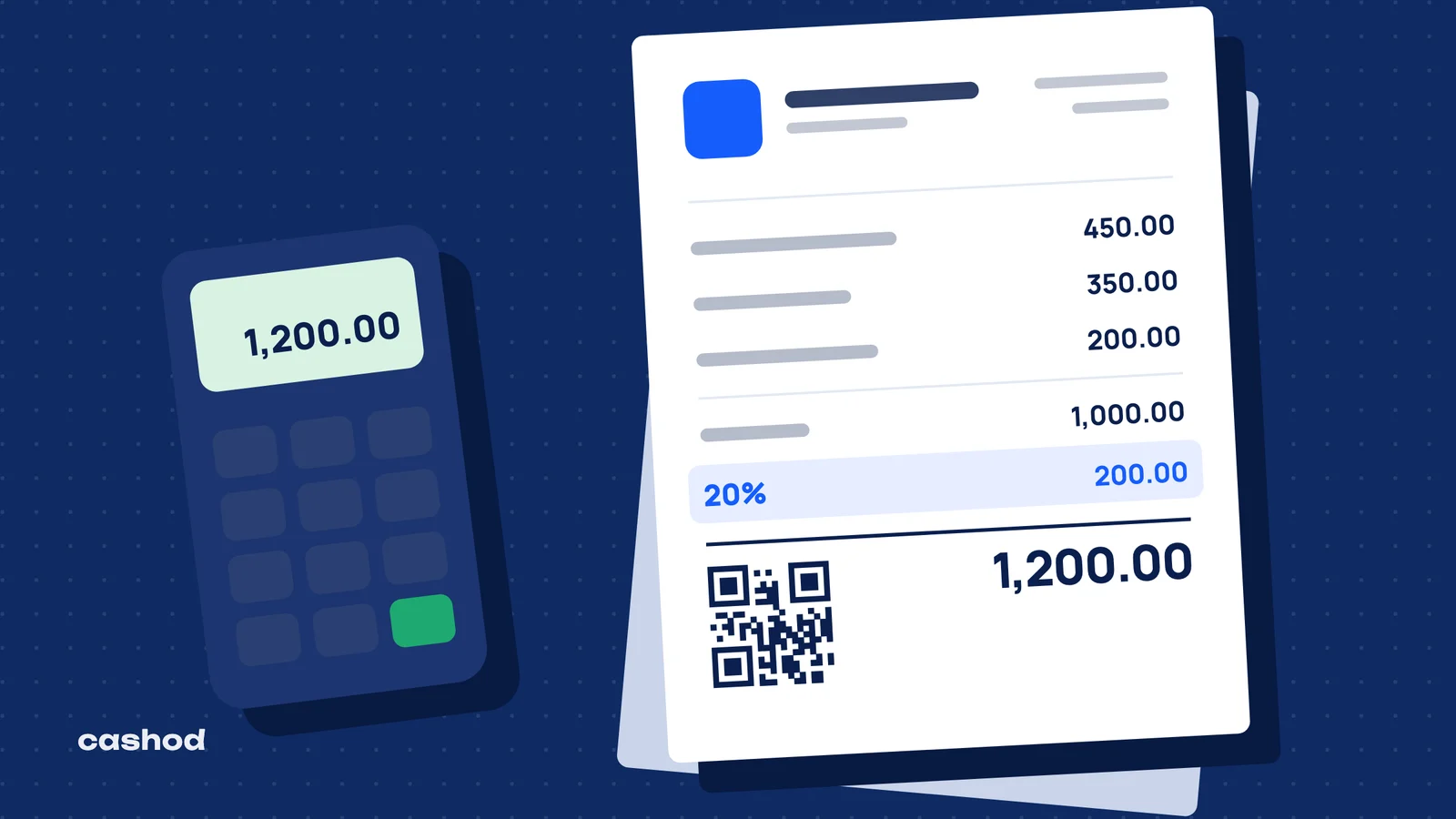
The arithmetic is simple. In Upsilon Consulting’s example, a trader sells an item at 100 DH before tax; with 20% VAT it sells at 120 DH including tax. If the trader bought it at 80 DH before tax, the supplier was paid 96 DH including tax. The trader pays the State the difference between VAT collected and VAT paid: 20 − 16 = 4 dirhams. Because COD prices are shown tax-inclusive, remember that at 20% the VAT is one sixth of what the customer pays.
What is taxed in a COD sale, and when
Timing. Under article 95 of the CGI, VAT falls due when the price is collected, in full or in part. For a cash-on-delivery seller that has two consequences:
- a refused parcel was never paid for, so it creates no VAT to declare;
- VAT is due on the price the customer paid the courier, not on the net transfer the carrier sends you after its fees. The carrier’s fees are a separate purchase, and you recover their VAT if the carrier gives you a proper invoice.
The courier collects on your behalf and pays you a few days later. Ask your accountant which date to use for the filing period, and keep both dates for every order. You can also opt for the debit regime, where VAT is due on invoicing, by declaring it before 1 January or when the activity starts; with COD, where some parcels come back, the cash basis is usually simpler.
Amount. Article 96 of the CGI includes in taxable turnover the price of the goods, the related accessory receipts and the costs attached to them. Delivery fees you charge the customer are therefore part of the base. And if you offer free delivery, the code states that for sales with home delivery, transport costs borne by the seller cannot be subtracted from taxable turnover, even when invoiced separately. To see what VAT, delivery and returns really leave on each order, rerun your numbers with our method for profit per delivered order.
What an invoice must show
The CGI requires taxpayers to give customers pre-numbered invoices from a continuous series, or printed by a computer system in a continuous series. On top of the usual commercial details, the invoice shows:
- the seller’s identity;
- the seller’s tax identification number and business-tax (taxe professionnelle) number;
- the date of the transaction;
- the customer’s name or company name and address, and the customer’s common company identifier (ICE);
- the price, quantity and nature of the goods;
- the VAT amount, shown separately, or the exemption that applies;
- the payment references and method;
- any other information required by law.
Your own ICE has been compulsory since the 2016 finance law added paragraph VIII to article 145 of the CGI: it must appear on invoices or the documents that stand in for them, and on every tax return.
For sales to private individuals, which is most of COD, the CGI accepts a till receipt in place of an invoice. It must show at least the date, the seller, a description of the product, the quantity and the price, with VAT where it applies. In practice many sellers put this receipt in the parcel or send it to the customer after delivery.
Two traps. First, never show VAT if you are not a VAT taxpayer: under the code, anyone who shows VAT on an invoice owes it by the mere fact of invoicing it. Second, keep numbering in step with delivery: a number given to a parcel that comes back must be cancelled cleanly, using a method your accountant approves, so the series stays continuous. Auto-entrepreneurs and taxpayers under the single professional contribution (CPU) are exempt from these invoicing and accounting rules, apart from giving the administration an email address.
Filing and paying VAT
Once liable, you first file a declaration of existence with your local tax office. Filing frequency then depends on turnover: returns are monthly if taxable turnover for the past year reaches or exceeds 1 million dirhams, quarterly otherwise (article 108 of the CGI). New taxpayers file quarterly for their first calendar year, and anyone who prefers monthly filing can ask for it before the end of January.
Returns are filed online on the DGI portal. Monthly filers must file their VAT return and pay what is due before the end of the month following the period; quarterly filers have until the end of the first month of the next quarter.
If you run several shops, note this: the CGI requires each return to cover all the operations of the same taxpayer. All your shops, brands and sales channels go into one return, and they count together for the thresholds.
Recovering VAT on your purchases
VAT paid on stock, packaging, carrier fees or software is deducted from the VAT you collect, on one condition: each purchase must be backed by a compliant invoice. No proper invoice, no deduction.
Cash brings two limits. The 2019 finance law limited companies’ use of cash to 5,000 DH per day and per supplier, and the CGI refuses VAT deduction on purchases paid in cash above those ceilings. On the sales side, the DGI does not allow cash payment when a transaction reaches 20,000 DH, on pain of a fine of 6% of the amount for the selling company. The code covers sales to private individuals as well, so for an order that size, offer a bank transfer or card payment instead of collection by the courier.
Finally, digital services from abroad. The 2024 finance law created obligations for non-residents supplying digital services to non-taxable customers in Morocco (article 115 bis of the CGI). If you are a VAT taxpayer paying foreign platforms for advertising or software, ask your accountant how to handle their VAT in your returns.
What to keep, and what is at stake
The CGI requires you to keep, for ten years and where you are taxed, duplicates of sales invoices or till receipts, expense vouchers and the accounting books. Article 211 of the CGI also requires those who keep electronic accounts to keep these documents electronically. For a COD seller, add each carrier’s payout statements, which show what was collected from customers and what was kept as fees.
Invoice fraud is a criminal offence. Article 192 of the CGI covers, among other things, issuing fictitious invoices and repeatedly selling without invoices. It provides fines of 5,000 to 50,000 DH plus one to three months in prison, and the Minister of Economy and Finance said in June 2025 that it was now being applied more firmly. The stakes are high for the State: according to Challenge, quoted by Le360, fake invoices cost between 40 and 50 billion dirhams in lost revenue.
Electronic invoicing is coming
The CGI already requires companies, taxpayers under the net real or simplified regime and VAT taxpayers to use an invoicing computer system that meets the administration’s technical criteria, with the details set by regulation, sector by sector.
According to the timetable reported by Le360, the first phase in 2026 targets business-to-government (B2G) operations and covers about 1,655 large companies with turnover above 200 million dirhams, close to 64% of the country’s economic volumes. Between 2027 and 2028 it extends to SMEs and mid-sized companies, and after 2028 to very small businesses, with simplified solutions. The final dates depend on the implementing texts.
For an online shop, the best preparation is to have, starting now, continuous numbering, complete customer records (with the ICE of business customers) and a catalogue where every product has its pre-tax price and its rate.
Keeping clean numbers with Cashod
VAT is worked out on what was actually collected, and that is where a COD shop’s numbers usually slip. Cashod tracks returned parcels, and each carrier’s delivery and return fees are set per city, so you can tell delivered and paid orders from those that came back, and find the fees to match against your carriers’ invoices. See returns management.
One Cashod account can manage several stores, which helps when every sale has to land in a single return. See multi-store. For the invoice itself, use a compliant invoicing tool and have your accountant approve your method.
Key points
- Retail reseller: VAT applies from 2,000,000 DH of turnover in the previous year; wholesalers and importers: from the first dirham.
- Two rates: 20% for most goods sold online, 10% for a closed list.
- VAT is due on collection: a refused parcel creates none, and the base is the price the customer paid, delivery included.
- Invoices numbered in a continuous series, with your ICE; a till receipt is enough for a private customer.
- Never show VAT on an invoice if you are not a VAT taxpayer.
- Keep invoices, receipts, vouchers and carrier statements for ten years.
- No cash from 20,000 DH.
This article summarises the 2026 edition of the General Tax Code; it is not tax advice. The rules change every year with the finance law, so check your case with an accountant and on the DGI portal before you decide. You can also model prices and margins with our COD calculator.